
Random Video Chat Etiquette: Features, Limits and Use Cases
Published 2026-09-22 · Updated 2026-10-25
Random video chat etiquette means asking without pressuring, listening without interrupting and accepting that either person can leave. If you are exploring 1v1 chat, begin with a greeting and a neutral question rather than a request for personal information. GoLive confirms browser access without installation, an optional Android app and 200 free coins at registration for new accounts. Those access facts are separate from the conversation habits discussed here. This guide offers example phrases for adult conversations, awkward questions and respectful exits; they are suggestions, rather than tested scripts or promises about another person’s response.

Key Takeaways
- A declined question is finished. Asking it again in different words still puts pressure on the other person.
- A brief goodbye is courteous when you feel comfortable. You can also leave immediately, without an explanation.
- Ask about a chosen interest rather than trying to identify someone’s home, workplace or private accounts.
- Courtesy does not prevent harassment. Another person’s misconduct is not a sign that your greeting needed improvement.
- A pause or a topic change is acceptable. You do not have to fill every silence or continue every interaction.
Defining Respectful Interaction Standards
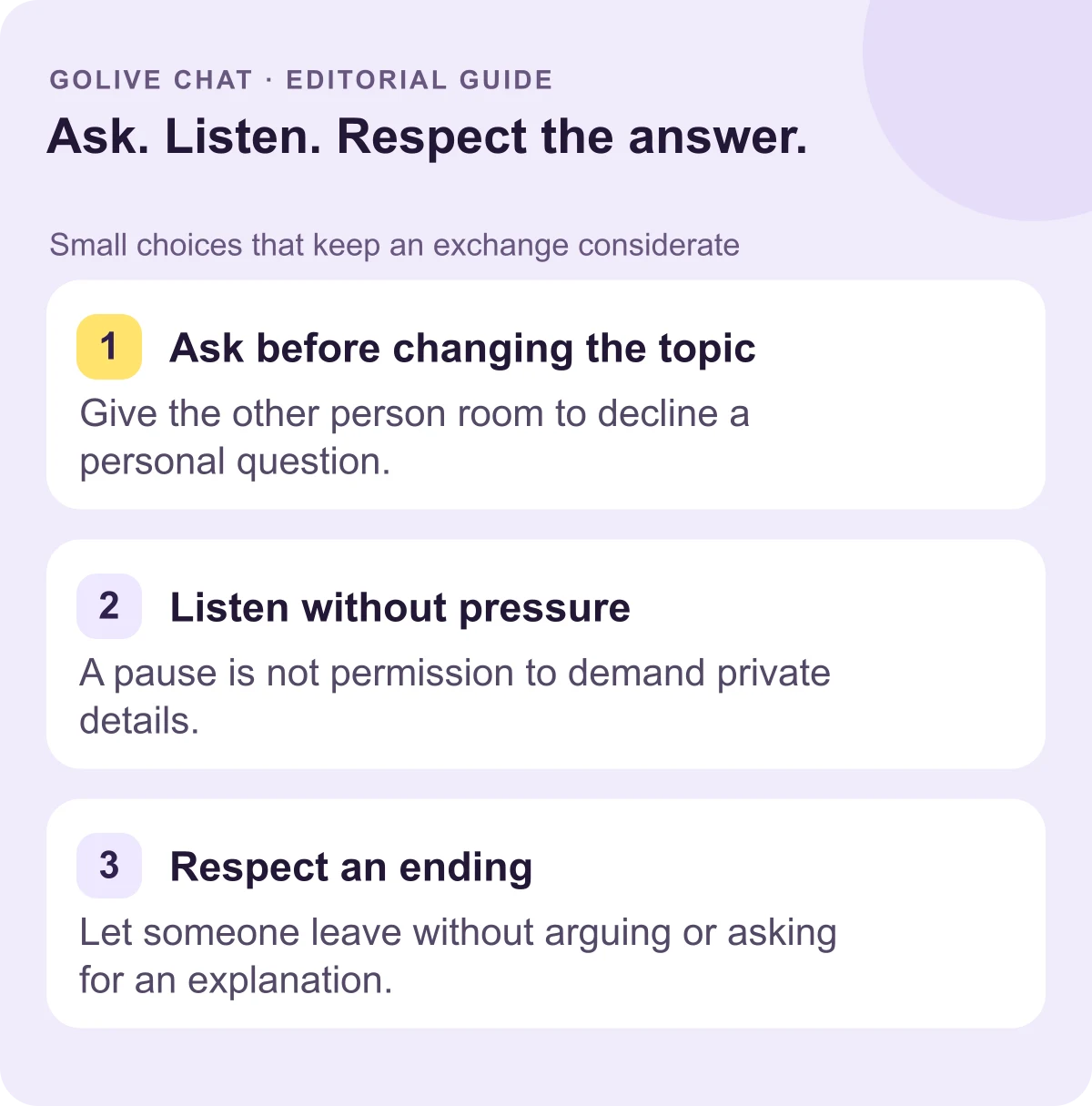
Respectful interaction starts with giving the other person room to decide what they want to discuss. That principle applies to GoLive Chat and to other settings where strangers meet. An introduction is an invitation, rather than a demand for someone’s name, location or attention. Let a short answer stay short, and leave space for a question in return.
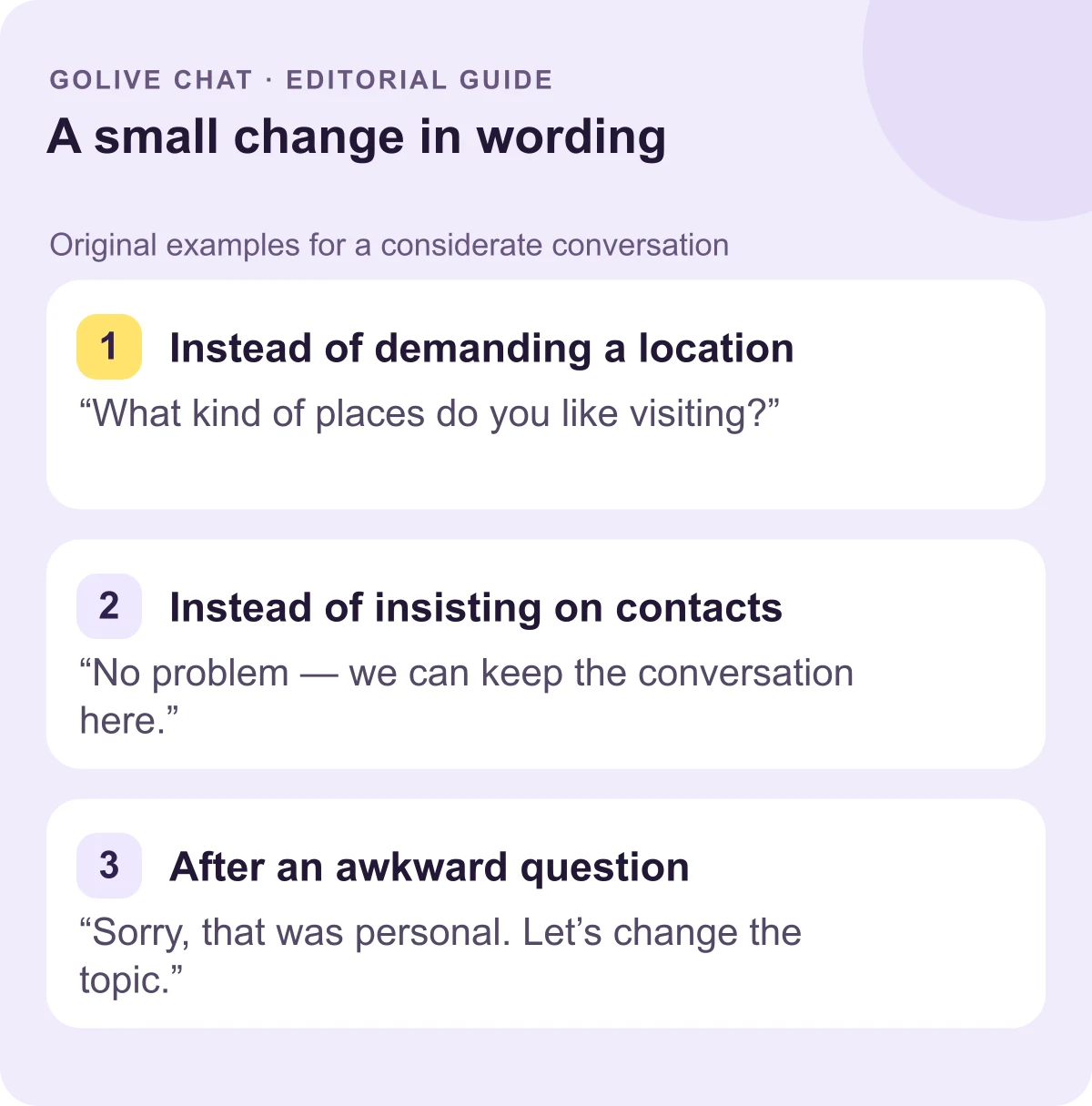
An interest is often a better starting point than an identity question. “Have you listened to anything good lately?” lets someone choose how much to share. “Which street do you live on?” asks for information that does not belong in an opening conversation. Even a question you consider ordinary may feel personal to someone else. Their choice does not need a justification.
Respect a decline the first time
If someone says they would rather keep a detail private, acknowledge that choice once and change direction. Avoid asking for a smaller version of the same detail, such as a neighbourhood after a declined address question. “No problem; we can leave that topic” is enough. Do not turn the refusal into a discussion of whether the person trusts you.
These examples illustrate different responses to a boundary:
| Situation | Respectful response | What to avoid |
|---|---|---|
| Someone declines a personal question | “Of course; let’s choose another topic.” | Asking for a reason or trying the question again |
| Someone does not want to exchange contacts | “That’s fine; we can leave it here.” | Treating an account handle as a condition of politeness |
| Someone says they need to go | “Take care.” | Demanding one more answer before they leave |
| You misunderstand a word | “Could you say that another way?” | Guessing their background or mocking an accent |
Navigating Conversation Flow and Boundaries
A conversation needs room for both people. Start with one question, hear the answer and respond to what was actually said. A list of prepared questions can be useful, but reading through it without listening can make an exchange feel like an interview. If someone mentions a favourite film, ask what they enjoyed about it before jumping to a different topic.
Take turns without measuring the pause
Audio delays or a simple hesitation can lead both people to speak together. Stop briefly and offer the turn: “You go ahead.” There is no fixed pause length that guarantees an uninterrupted conversation. If hearing each other is difficult, acknowledge the difficulty rather than repeating a personal question more loudly.
- Offer a short greeting. Give the other person an opportunity to respond before adding another question.
- Choose a neutral topic. Music, food or an activity can leave more room for choice than questions about identity.
- Follow the answer. Respond to one detail instead of assuming the next topic must come from your list.
Keep permission specific
Agreeing to a conversation does not mean agreeing to every topic, a private contact exchange or a recording. Ask separately when a request changes what the other person is being invited to do. A hesitant response is a reason to stop the request, rather than negotiate it. Avoid recording or sharing someone’s image or words without their informed permission; a casual yes should not be treated as a complete legal clearance for every later use.
GoLive’s welcome-offer page describes 200 free coins at registration for new accounts. A welcome amount is an account offer, rather than a reason for anyone to keep talking or share a detail they would prefer to withhold.
Applying Etiquette in Real-Time Chats
When a question lands badly, repair the moment without asking the other person to reassure you. “Sorry, that was too personal; we can leave it there” acknowledges what happened and closes the topic. A long explanation of your intentions can keep attention on the very question they wanted to avoid. After a brief acknowledgement, let them choose whether to continue, change the subject or leave.
You can also set your own boundary directly: “I’d rather not discuss where I live.” You do not need to invent an excuse or replace the answer with another identifying detail. If the response is respectful, a neutral topic may be an option. If the request continues, end the interaction. The 1v1 video chat guide provides context on the format; these phrases are illustrative suggestions, rather than evidence of a particular service’s controls or outcomes.
Identifying and Handling Disrespectful Behavior
There is a difference between an awkward question and a person repeatedly ignoring a clear boundary. Someone may misunderstand a word, speak over you accidentally or ask a question you do not want to answer. You can decline without deciding whether they meant harm. Repeated demands after the decline are enough reason to stop engaging.
Notice pressure rather than explaining it away
Watch the response to a boundary. “I’d rather not share that” should not become an invitation to bargain. Phrases such as “You would tell me if you trusted me” put responsibility for the other person’s demand onto you. You do not have to prove friendliness, courage or authenticity by disclosing personal information or accepting a recording.
Possible reasons to leave include:
- A person repeats a request for contact details after you have declined.
- They make insulting remarks or insist that you respond to an unwanted topic.
- They ask you to demonstrate trust by revealing information you want to keep private.
Leave without winning the argument
When comfortable, use a short exit: “I’m going to go now; take care.” If you feel threatened or simply want to stop, leave without a goodbye. Courtesy is a choice available in a comfortable exchange, not a condition you must meet before ending an uncomfortable one. You are not responsible for providing a lesson in manners to someone who continues to pressure you.
For further help with serious abuse, Australia’s eSafety Commissioner [3] publishes guidance for adults. Its reporting scheme has Australian eligibility rules; use the relevant local service for your situation. That resource is separate from any chat operator’s own support process and does not establish which reporting tools GoLive provides.
Limits of Personal Conduct Strategies
Etiquette describes choices you can make. It cannot establish a stranger’s identity, prevent someone from behaving badly or guarantee that an interaction will be pleasant. A thoughtful opening question is still worthwhile as a way of expressing respect, but another person’s reaction is theirs. Do not treat an uncomfortable encounter as proof that you failed to choose the perfect words.
Avoid turning courtesy into a performance
You can be quiet, speak imperfectly or decide that you are not enjoying an exchange. Those choices do not make you rude. An apology is useful when you have crossed a boundary; it is not something you owe for every pause, declined question or decision to leave. Do not keep a conversation going just to reach a polite ending that the other person keeps moving further away.
The same principle works in the other direction. If a person leaves after a short exchange, avoid inventing a story about their motives. They may have many reasons to stop, and they do not owe you an explanation. Accepting an exit is part of respecting choice, even when the conversation had seemed comfortable to you.
Separate access facts from behaviour advice
The 1v1 video call access information confirms browser access without installation and an optional Android app [2]. Neither access route tells you how a particular stranger will behave. When considering a service, read its current access information separately from general conversation advice. This etiquette guide does not measure outcomes, rank moderation systems or assign a number of conversations to a coin balance.
Conclusion
Ask without insisting, listen to the answer and accept that either person may stop. A brief repair can acknowledge an awkward question, while a direct boundary can protect a topic you want to keep private. Neither requires a promise to continue. For GoLive’s current access information and its stated 200-coin registration offer, visit the official page for 200 free coins. Keep those account facts separate from expectations about how a conversation will go.
Sources
FAQ
What if someone declines my question?
Accept the decline and change the subject. Do not ask for a reason or offer a slightly reworded version of the same question.
Is it rude to leave quickly?
You can leave whenever you want. A short goodbye is a courtesy when you feel comfortable, but you do not need to explain an immediate exit.
What if we both speak at once?
Pause and offer the other person a turn. If audio or hesitation makes the exchange difficult, acknowledge it without assuming that anyone is deliberately interrupting.
Does politeness prevent harassment?
No. Courtesy expresses your own choices; it cannot control someone else’s behaviour, and harassment is not your fault.
Does GoLive require an app installation?
GoLive confirms browser access without installation and an optional Android app. New accounts receive 200 free coins at registration.
New users get 200 free coins when they register with GoLive Chat. GoLive Chat works in the browser without installation. An Android app is also available.
Start 1v1 video chat — get 200 free coins